Lineage of Korean Taoism
This work embodieds a contemporary interpretation of Hanbaegum, based on a visionary dream exprenced by Solgeo, a distinguished painter of the Silla Dynasity in Korea.
Korean Taoism, Seondo
This tradition was transmitted through Master Bongwoo Kwon Tae-Hoon, a Korean Legendary Tao master(Seon-in, 仙人), who began teaching his disciples in 1930 in the valley of Gapsa Temple on Gyeryongsan Mountain, Korea. His teachings continued an ancient lineage of Korean Taoism and Seondo practice passed down over 12,000 years.
The purpose of this tradition is to realize the ideal of Hongik-Ingan (弘益人間)—to live in a way that widely benefits all humanity. This principle originates from the teachings of Daehwangjo-Hanbaegum (大皇祖), the Great Forefather, who is regarded as the first enlightened teacher of humankind and the ancestral forefather of the Korean people.
The foundational method of practice consists of three essential principles:
- Stopping harmful intentions (Ji-Gahm, 止感)
- Practicing Tao breathing meditation (Jo-Sik, 調息)
- Stopping harmful actions (Geum-Chok, 禁觸)
These principles form the basis of mental and spiritual cultivation in Korean Taoism and Seondo. They have been preserved and transmitted over long periods of Korean history.
Over time, this wisdom traveled beyond the Korean Peninsula—into China, across the Kunlun Mountains into regions of Minor Asia(Turkiye areas today and near Black Sea, Aegean Sea, and Mediterranean Sea), and across the Tianshan Mountains into India. Through these transmissions, the teachings later influenced Confucianism and Taoism in China, Buddhism in India, and spiritual traditions that developed into Islam and Christianity in parts of Minor Asia.
Although expressed through different cultures and customs, the underlying principles of this tradition are shared across major philosophical, spiritual, and contemplative systems. The differences lie primarily in cultural form rather than in essential meaning.
This path of practice is open to all people, regardless of religion, occupation, gender, social condition, or wealth.
<Announcement to the Baekdoosan Mountain tribes> written by Master Bongwoo Taehoon Kwon
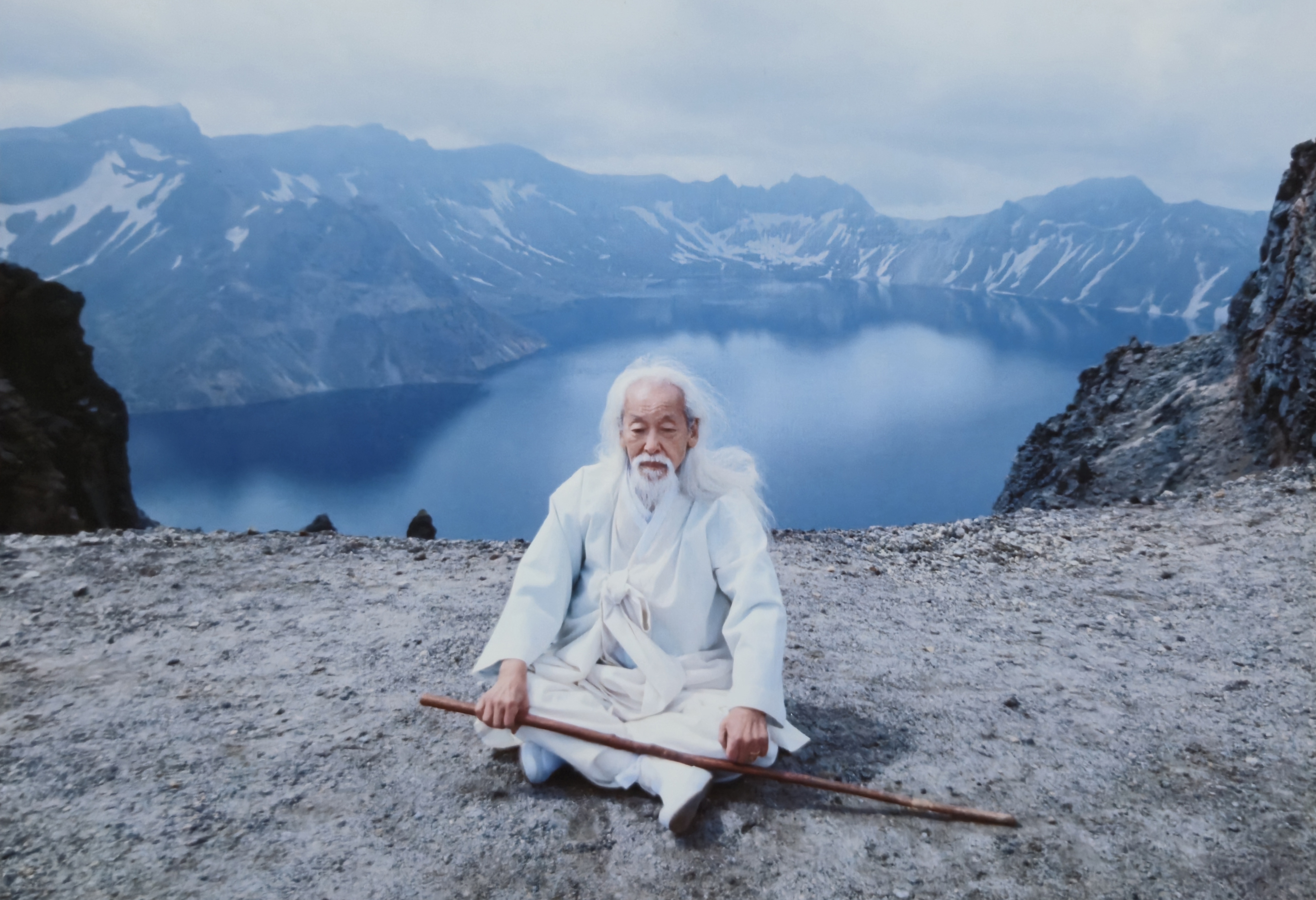
Legendary Master Bongwoo
Master Bongwoo Taehoon Kwon (1900–1994)
(His spiritual name, Bongwoo means Phoenix of Universe)
Born on January 20, 1900 (lunar calendar) in Jaedong, Seoul. His father was Kwon Jong-myeon, who held the position of Director of the Internal Affairs Bureau of the Korean Empire, and his mother was Lady Kim of Gyeongju, the daughter of General Chiljong Sangho.
At the age of six, he learned the traditional Korean spiritual training method, the Jo-sik method, from his mother.
At the age of eight, he completed all the basic classics of Chinese studies, including the Four Books and Five Classics.
In 1909 (age 10), he met and received teachings from Master Na Cheol at the Dangunkyo (now Daejonggyo) missionary hall in Madong, Jongno, Seoul, and joined the religion.
In 1912 (age 13), he first met Master Kim Il-song, a master of the Korean traditional spiritual path, in Yeongdong, Chungcheongbuk-do.
In 1913 (age 14), he visited and met Master Gwak Jong-seok, a leading figure of the Yeongnam Confucian scholars.
In 1914 (age 15), he met Tanaka Suihei of Taireido, the master of hypnotism Tamiyakaru, Koyu Tetsuseki, Hara Senbutsu, a leading figure in the Japanese spiritual world, and his disciple Kihara Kibutsu in Japan, and experienced the Japanese spiritual training world.
In 1918 (age 19), he entered Mount Guwol in Hwanghae-do and underwent spiritual training under the guidance of Master Il-song.
In 1919 (at age 20), he entered Manchuria and began armed independence struggles under General Kim Kyu-Sik of the Northern Military Government.
In 1924 (at age 25), after realizing his past life during spiritual training, he visited Zhujiazhuang in Shandong Province, China, to confirm it. Later, he met Wang Jingren, a legendary immortal of the time, on Mount Luofu.
In 1929 (at age 30), he made his third trip to China. He interacted with politicians such as Wang Jingwei, Wu Chaoshu, Gu Weijun, Feng Yuxiang, Lu Zhongxiang, and Yuan Kewen. He observed the traditional Chinese spiritual training system, "Qianri Chan" (Thousand-Day Meditation).
In 1948, he gathered his comrades in a cave below Sambulbong Peak on Mount Gyeryong and conducted joint training. He named it "Yongsan Yeonjeongwon" (Institue of Bongwoo Tao Meditation). He served as a central executive committee member of the Korean Independence Party led by Kim Gu and as the chairman of the Gyeryongsan Special Committee.
In 1964, he moved to Seoul and opened a traditional Korean medicine clinic.
In 1982, he was inaugurated as the 12th Grand Patriarch of the Daejonggyo national religion.
In 1984, he published the novel "Dan," based on his oral accounts and written by author Kim Jeoung-bin. This novel became a bestseller, selling hundreds of thousands of copies.
In 1986, he became the chairman of the Confucian Association and the president of the Korean Danhak Association Yeonjeongwon.
In 1989, he published the essay collection "A Message to the Baekdu Mountain People" and, through oral accounts and supervision, "The Secret of Cheonbugyeong and Baekdu Mountain Tribe Culture."
In 1990, he performed a heavenly ritual at Cheonji Lake on Mount Baekdu.
In 1992, he published "The Secret of Tao Spiritual Training Methods" based on his oral accounts and supervision. He passed away on May 16, 1994, at his home in Sangsin-ri, Gyeryongsan Mountain.
Related books:<The Immortal Who Leapt into the World>, <Bongwoo's Diary>, <The Spiritual World of Bongwoo the Immortal>, <Studies in Sundo>, etc.

Heartmoon Haejung Ocean
Director, Bongwoo Tao US
Sedona, Arizona, is a spiritual sanctuary where seekers from around the world come to experience the profound energy of its red rock canyons. Here, visitors begin healing journeys that embrace the soul, mind, body, and spirit. True to the meaning of her spiritual name, “Heartmoon,” Haejung welcomes others with compassion and creates spaces for healing, laughter, and authentic connection. Through her work, she supports people in awakening awareness and deepening their relationship with their inner nature, their families, their communities, and Mother Earth.
Haejung earned a Bachelor’s degree in Information and Communications Technology in Korea, but soon recognized that her true calling was to support others. She went on to work with yoga and meditation organizations, eventually serving as Director of U.S. Activities. During her years in Manhattan, she managed a Tao yoga and Tai-chi center, guided clients toward healthier lifestyles, and taught yoga and meditation at Borough of Manhattan Community College.
After moving to Sedona, Haejung served as Director of the Sedona Meditation Center for five years before opening her own studio. She specializes in yoga, meditation, and Tao-based practices, while also supporting individuals with lifestyle and nutritional guidance to help them cultivate balance and well-being.
In 2020, Haejung received the Bongwoo Tao Meditation practice through the direct lineage of Master Bongwoo. Rooted in deep breathing and inner reflection, this traditional Korean practice supports personal insight and awakening. She continues to share this work through annual Korean and Sedona Tao Meditation Retreats and the “Rising – Tao Breathing Meditation App,” available on the Apple App Store, and looks forward to connecting with more people through the Bongwoo Tao website.